The public story around wireless exposure is often presented as settled science and neutral governance.
But when regulatory standards are narrow, when funding streams shape research priorities, and when delay consistently benefits infrastructure build-out, patterns emerge.
The question is not whether wireless technology has benefits. The question is whether the full spectrum of biological evidence is allowed to meaningfully influence policy — or whether it is filtered through a harm model designed to protect profit.
Evidence Exists — The Story Is Managed When substantial biological findings are repeatedly reframed as “inconclusive,” the issue is not absence of data but control of interpretation.
Research documenting oxidative stress, altered signalling, and developmental sensitivity does not disappear — it is categorised as outside the regulatory definition of harm.
A narrow harm model can make robust findings look irrelevant.
Financial Flows Shape Scientific Emphasis Funding ecosystems influence which hypotheses are prioritised, replicated, amplified — or quietly sidelined.
When industries with trillions in infrastructure at stake fund research, lobbying, and public messaging, the resulting narrative stability should not be mistaken for neutrality.
A genuinely neutral system would have huge financial repercussions.
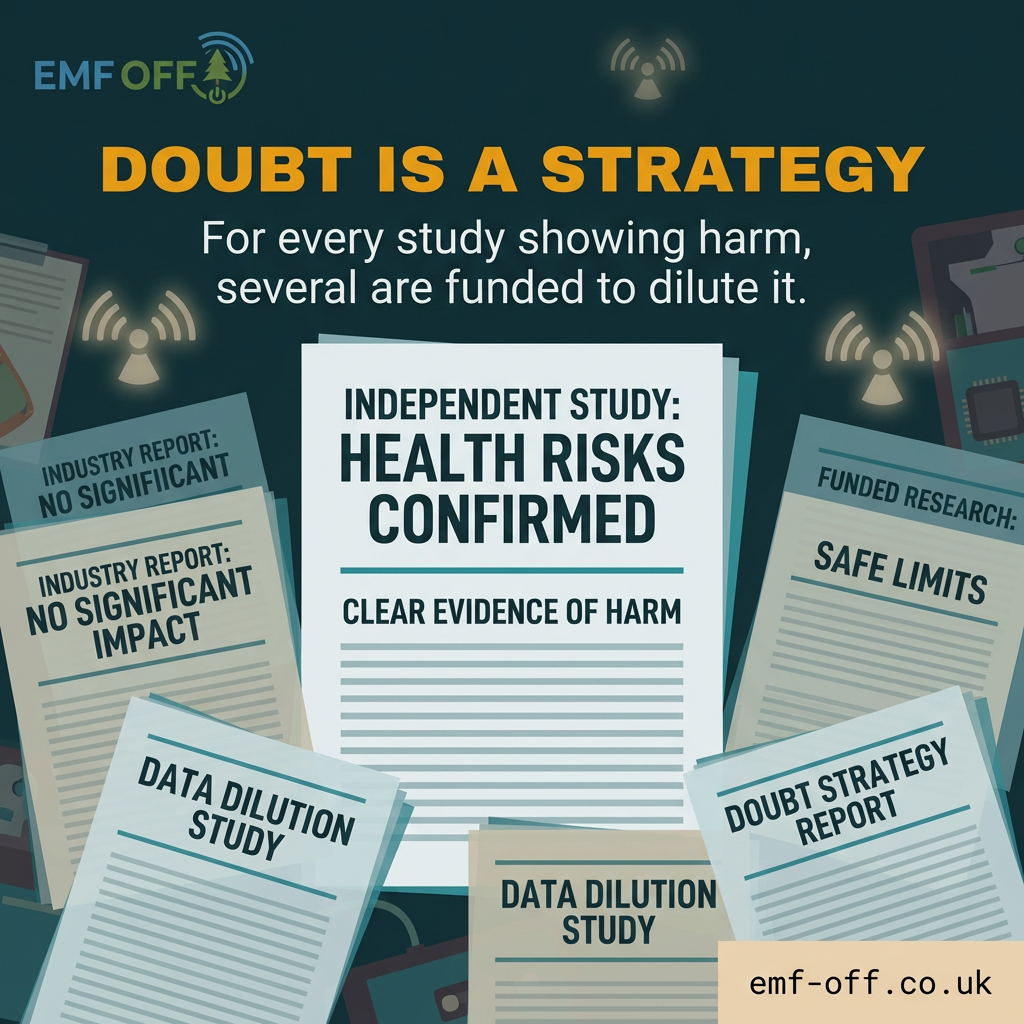
Manufactured Uncertainty as Risk Management A single independent study reporting harm can be countered not by refutation, but by volume — multiple narrowly designed studies reporting “no significant effect.”
This does not resolve the biological question. It dilutes its clarity.
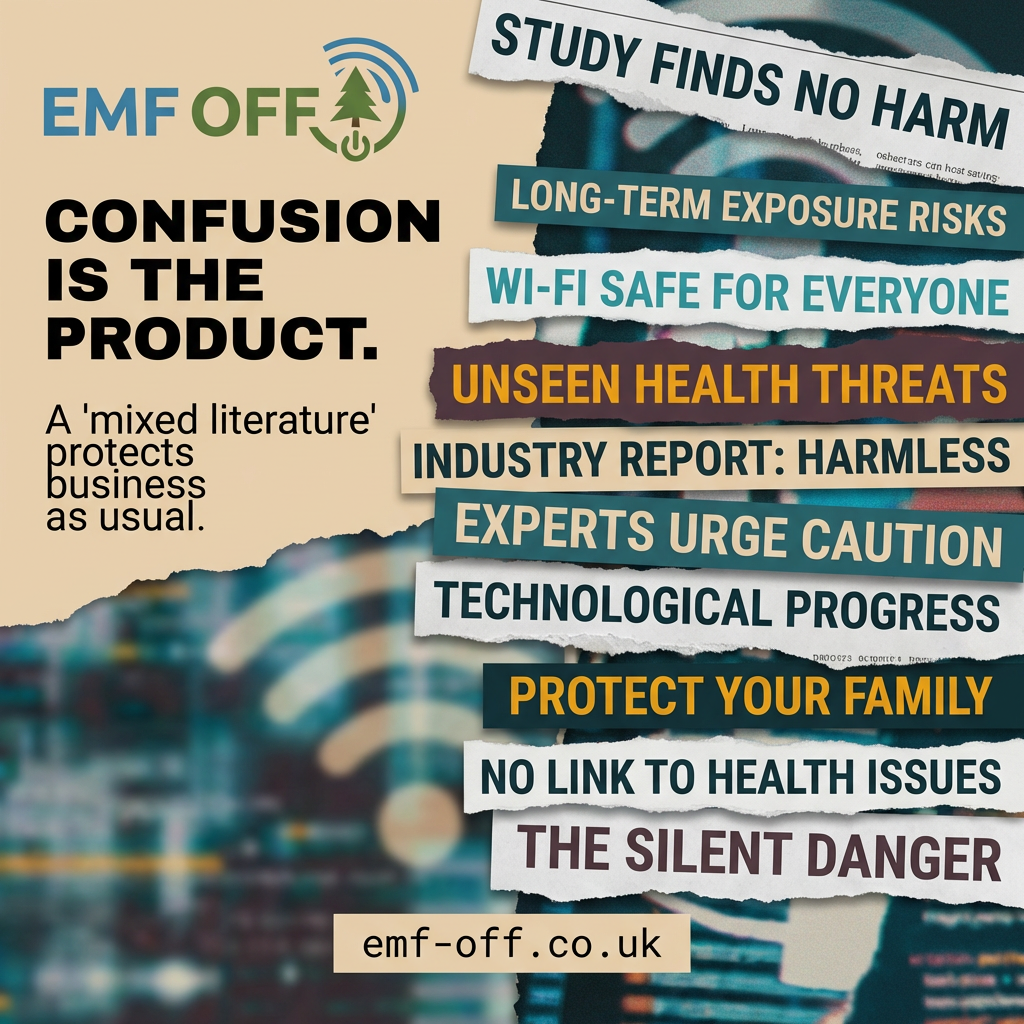
Confusion is protective when liability is expensive.
Design Determines What Can Be Found Real-world exposure is chronic, cumulative, and layered across devices and environments.
Laboratory protocols frequently isolate short durations, fixed distances, and simplified signal types. Predictably, such designs struggle to capture long-term or developmental outcomes.
If methodology excludes lived conditions, conclusions will mirror that exclusion.
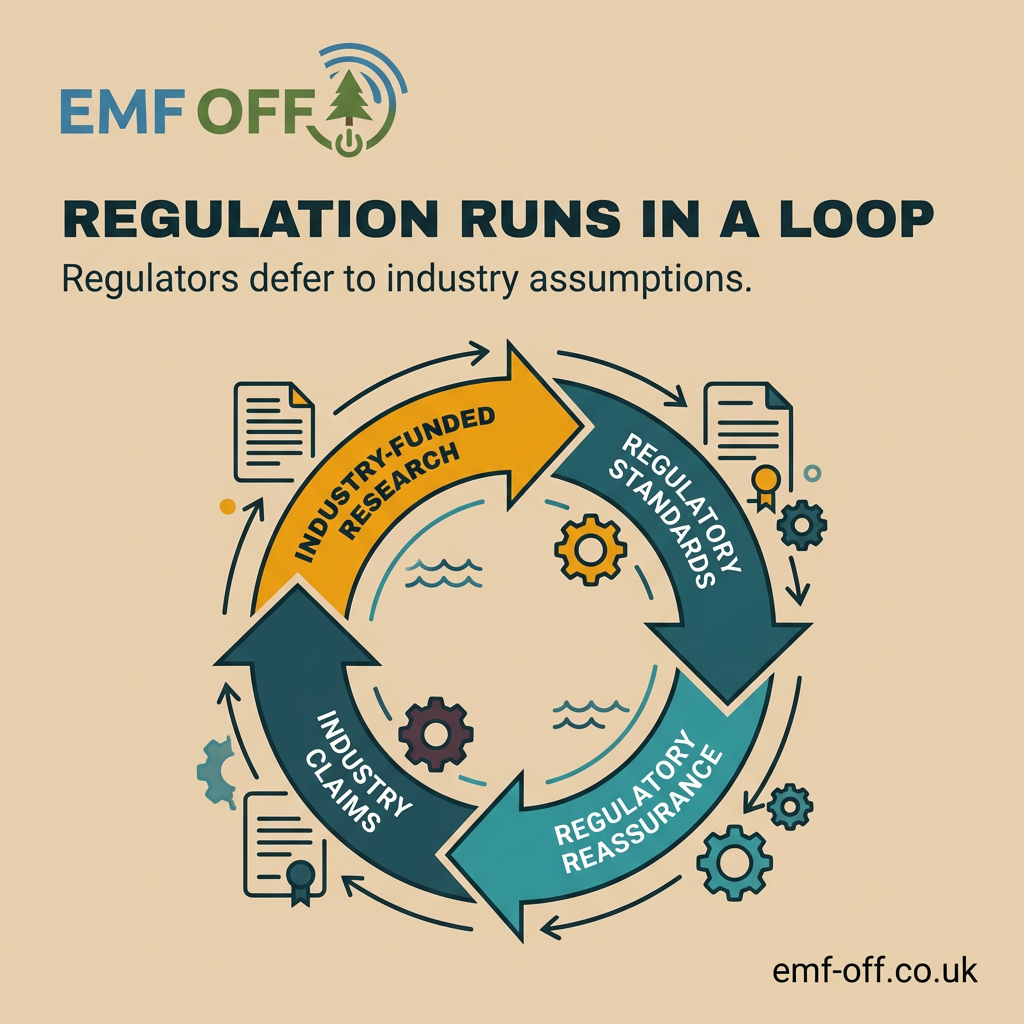
Circular Governance and Self-Referencing Standards Industry-funded research informs regulatory thresholds. Those thresholds then validate industry claims of safety. Regulators cite compliance with those same thresholds as reassurance.
The loop is procedural — and powerful.
When the same assumptions circulate through research, standards, and messaging, dissenting data struggles to gain traction.
Absence of Regulatory Action Is Not Absence of Risk “No proof of harm” often reflects the boundaries of what regulators are authorised to recognise — typically acute thermal effects.
When the bar is set to detect only one mechanism, others become invisible.
Delay Converts Uncertainty into Infrastructure Calls for “more long-term data” sound prudent. But during the waiting period, networks expand, towers multiply, and exposure normalises.
Once embedded into cities and schools, reversal becomes politically and economically improbable.
Time, in this context, favours permanence over safety.
Economic Incentives Favour Wireless Density Fibre deployment is capital-intensive and geographically constrained. Wireless scaling is comparatively rapid and cost-efficient.
Lower deployment cost and higher return on infrastructure naturally bias system-level decisions.
Profitability can quietly determine exposure pathways.
Embedding Infrastructure in Sensitive Environments Schools represent long-term, high-density occupancy environments — precisely where developmental sensitivity warrants caution.
When infrastructure is installed early and framed as indispensable, reconsideration becomes socially and politically difficult.
Normalization reduces scrutiny.
Information Overload as Containment A “mixed literature” can emerge not because effects are absent, but because study design, endpoints, and funding sources vary widely.
The resulting noise allows stakeholders to emphasise reassuring findings while minimising mechanistic signals.
Clarity Is Proportional Response Recognising regulatory narrowing, funding influence, and methodological constraints is not extremism.
It is a structural analysis of how risk is filtered before reaching the public domain.
Identifying patterns is the first step toward accountable governance.
Precaution Aligns with Biological Responsibility When biological systems show measurable response to chronic exposure, waiting for categorical certainty is not neutral — it is a decision.
Reducing unnecessary exposure, especially for children, is compatible with technological use.
Precaution is rational when stakes are developmental and effects may be cumulative.