This project was never about panic. It was about restoring proportion in a conversation narrowed by economic interests and regulatory framing.
When evidence is filtered through standards designed around thermal thresholds alone, non-thermal biological findings are treated as peripheral — regardless of replication or mechanistic plausibility. That narrowing protects infrastructure stability and market continuity. It does not necessarily protect physiology.
The conclusion is simple: awareness is rational, reduction is reasonable, and personal action does not require institutional approval.
Attention, Not AlarmRecognising risk signals is not hysteria.
It is a measured response to a body of literature showing biological interaction beyond heating alone.
When regulatory categories exclude mechanisms that are experimentally observable, public calm is maintained — but clarity is not.
This was about informed attention, not fear.
Disputed Does Not Mean AbsentThousands of peer-reviewed studies document oxidative stress, calcium channel modulation, DNA effects, and neurobiological changes under non-thermal conditions.
What is often labelled “uncertain” is frequently evidence that challenges existing regulatory assumptions.
Economic dependence on wireless infrastructure creates structural resistance to expanding definitions of harm.
Scientific contestation often follows financial exposure.
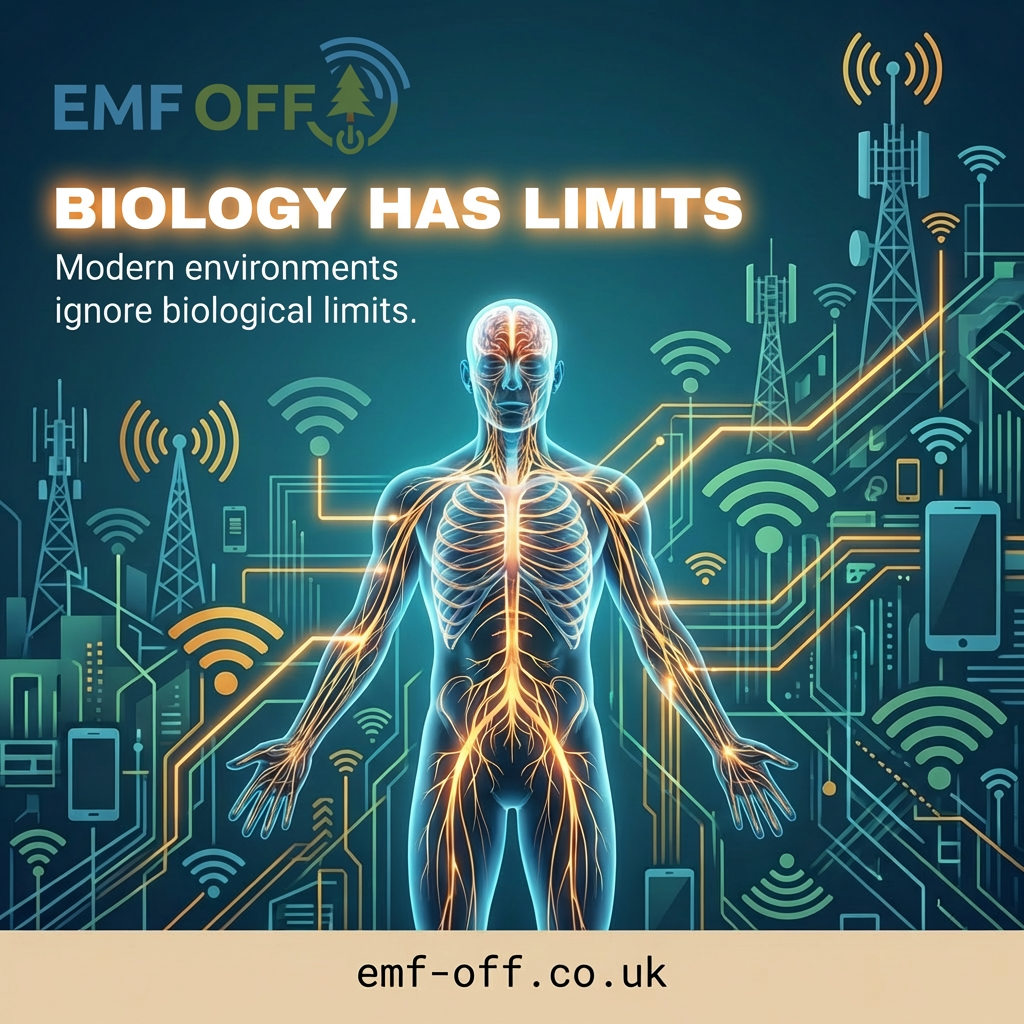
Physiology Has BoundariesHuman biology evolved in a comparatively low-intensity electromagnetic background.
Modern signal density — continuous, pulsed, and overlapping — is historically unprecedented.
When exposure exceeds adaptive capacity, dysfunction emerges gradually, not dramatically.
Biological limits do not negotiate with market timelines.
Early Responders Are Not IrrationalSome individuals register environmental shifts sooner.
This does not invalidate their experience — it often highlights sensitivity within shared pathways such as autonomic regulation and oxidative balance.
Population-wide thresholds are built around averages; biology is not average.
Early feedback is a signal, not a flaw.
Pragmatism Over PermissionIf a behavioural change is low cost, reversible, and biologically plausible, waiting for regulatory revision is unnecessary.
Precaution is a rational decision under incomplete institutional acknowledgement.
Historical public health reversals show that regulatory inertia can outlast early evidence.
Reasonable reduction requires no external validation.
Protection Is a Parental and Personal RightSafeguarding sleep environments and children’s exposure is not extremism.
Developing systems are more sensitive to environmental input, and long-term cumulative exposure cannot be studied in advance of time.
Precaution in private space harms no one and compromises no one’s connectivity.
You do not need consensus to prioritise care.
Function Over NarrativeThe most practical metric is functional change: sleep depth, cognitive clarity, autonomic stability, recovery speed.
If reduction improves measurable well-being, that outcome stands independent of regulatory language.