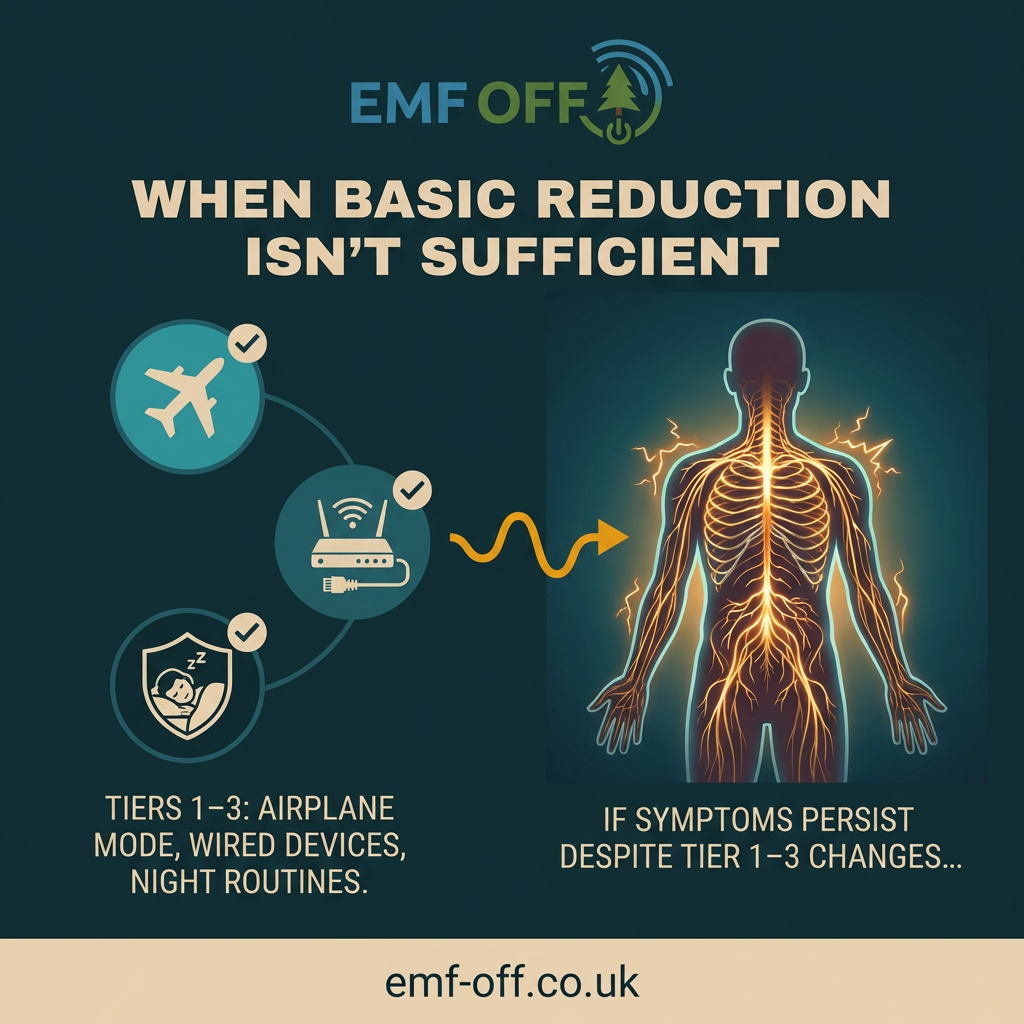
Basic changes reduce personal contribution to the signal environment — they do not necessarily resolve exposure in dense or EMF saturated areas.
This section addresses what happens when symptoms persist despite foundational steps. It clarifies why advanced mitigation exists, who it is for, and why escalating action does not imply irrationality — it reflects the reality that regulatory definitions do not encompass all scenarios and needs.
The goal is not fear. It is proportional response in a system where policy lags behind evidence.
Escalation Is Context-DependentNot everyone requires structural mitigation.
But when exposure is constant, cumulative, or externally driven, basic behavioural steps may not shift total load enough to change outcomes.
Advanced measures exist because some environments are biologically louder than policy acknowledges.
Proportional response depends on total signal density — not public messaging.
When Foundational Changes Don’t Resolve SymptomsAirplane mode, wired devices, and night routines reduce voluntary exposure.
They do not eliminate neighbour Wi-Fi, cell infrastructure, smart meters, or building wiring fields.
If symptoms persist, that does not invalidate lived experience — it indicates unaddressed exposure pathways.
Regulatory silence is not the same as biological absence.
Cutting Power at the SourceAlternating current wiring produces electric fields even when devices are not actively in use.
Removing power from sleeping areas reduces continuous ambient fields during peak repair hours.
This is rarely discussed because standards focus narrowly on heating thresholds — not chronic background exposure.
Recovery requires signal quiet, not just device discipline.
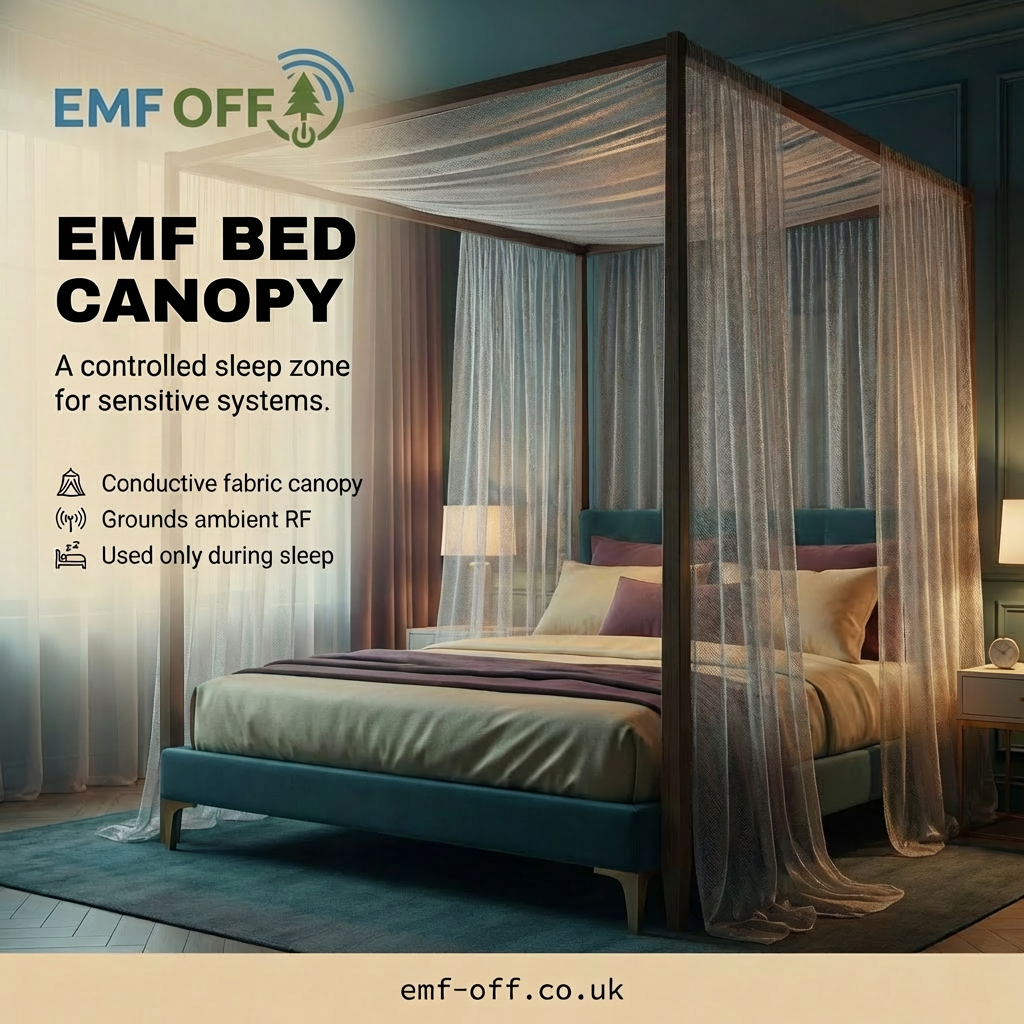
Creating a Shielded Sleep Micro-EnvironmentConductive canopy systems work by attenuating ambient radiofrequency fields within a defined zone.
This is not about fear — it is about recognising that nighttime is when cellular repair and glymphatic clearance intensify.
If the broader environment cannot be altered, micro-environments become a practical solution.
When policy does not protect, architecture can.
Choosing Infrastructure Over TransmissionHard-wired systems eliminate background broadcasting within the home.
This reduces continuous signalling rather than simply limiting active use.
Wireless convenience is economically entrenched; wired stability is biologically quieter.
Navigating High-Density Public SpacesAirports, trains, offices, and hotels concentrate overlapping signals from hundreds or thousands of devices.
Situational tools — pouches, shielding garments, strategic seat selection — are mitigation responses to environmental saturation.
The absence of regulatory recognition does not eliminate physiological load.
Some environments are structurally intense by design.
Quantifying Before InterveningAssumptions about exposure are often wrong.
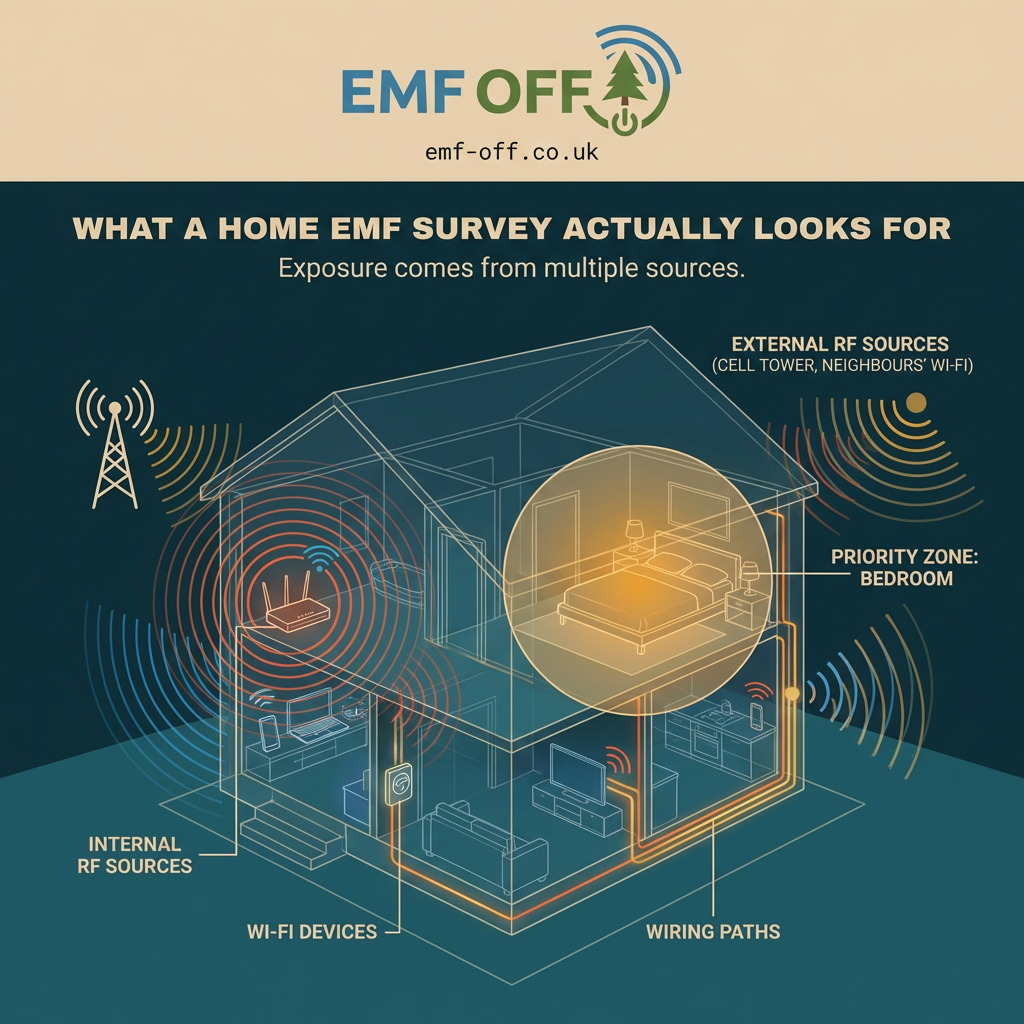
Measurement distinguishes internal sources from external ones and identifies priority zones.
Without data, reduction becomes guesswork — and guesswork protects neither health nor credibility.
Evidence should guide mitigation, even when policy lags behind it.
What Comprehensive Surveys Actually RevealExposure enters from multiple vectors: neighbour routers, nearby infrastructure, internal wiring paths, and personal devices.
Bedrooms are priority zones because exposure during sleep compounds nightly.